Thursday, June 5, 2014

Bracebridge History Sketches and The Unsung Heroes; Willy Andison The Hospital Gardener With A Little Bit Extra; Cecil Porter A Fine Historian

Bracebridge Fire Brigade, undated above and train crossing the rapids above the Bracebridge Falls


NOTE: At the time of posting this blog, we (Suzanne and I), learned of the passing of Gravenhurst Historian, Cecil Porter who I greatly respected, especially for his outstanding book on Camp  20 entitled "The Gilded Cage", which I quoted in numerous blogs last week. You can archive these columns on the German Prisoner of War Camp through this blog. I will offer a further tribute in tomorrow's blog.

COMMUNITY HISTORIES TREND TOWARD CELEBRITY, THE VICTORIOUS, POLITICAL ACCOMPLISHMENT, BUSINESS SUCCESS AND PRIVILEGE

BUT THEY AREN'T THE SOLE HISTORY MAKERS, AS PRINT MIGHT LEAD YOU TO BELIEVE

     If you have read my blog(s) for any length of time, and ponder occasionally, the rationale, as I jog in words, from town to town, Walden Pond to the lakes of Algonquin, you will also recognize, a hundred or so names that I refer to regularly. A percentage of these names, belong to former friends and associates of mine, from a variety of community, business and professional interactions. Not that I am their sole means of staying current, but pretty much. These folks have departed this mortal coil, and I guess keeping their names out-there, is my way of making sure their contributions to our region, and community aren't forgotten.
    My point is, many community historians do the same thing, although they might not come right out and admit it; because unless it's a biography, we in this field, doing general histories, are not supposed to play favorites. Sometimes we justify it, because of the purpose of the book, such as its specific field of study, where obviously, certain names are going to appear more than others. Like newspaper reporters, from my day at least, we are supposed to be unbiased writing-up a news story. It's the reason, as editor of The Herald-Gazette, I wouldn't allow any reporter, to write an editorial on the opinion page, following-up a story they had written, for example, on the front page. I consider it a conflict of interest, and ethically questionable.
     Personal opinion is okay when everyone knows it's a viewpoint piece. In general histories, bias does get into the copy, and there are folks who get far more coverage than they deserve. I'm usually written-out of these histories, with a few exceptions, so believe me, I know how it works from all sides. It can be a daunting exercise, to try and straddle that wavering middle line, so that someone or other isn't offended by the finished product. As the writer of some of these histories, it drives me crazy at times, trying to cover and recognize everyone connected. If my critics don't believe me, they are welcome to review my past work. I feel remarkably empowered just by the fact I've bestowed credit to others. I am not self-made as either an historian or writer. And I will never shortchange giving full credit, just because there are too many names to mention.
     Bracebridge, and the accounts of its history, are just like thousands of other community histories, across the continent. I should know, because I have sold, as an old book dealer, a large quantity of regional Americana and Canadiana; having read through a lot of these titles, before putting them out for sale. The argument these writers would throw back, at the critic, is that there can't be total inclusion in such general, community histories, because it would take thousands of pages, and way too much ink. The cost to produce such a book would be outrageous. I get it! So by economy, and the fact, most historians couldn't afford the time, to write-up the accomplishments of every citizen, who helped forge the chronicle of good villages, towns and cities, it's to be forgiven, then, that certain standards have to be imposed, as sensible proportion, to story and story-makers. What this means, in essence, is that when you read one of these lengthy historical overviews, you will thusly appreciate how narrow the focus is, on the individuals of promimance, who get most of the credit for forging the town chronicle. It's a standard thing, and it's no better or worse in Muskoka, than anywhere else; that well meaning historians, have tried, and succeeded in part, to document in the body of a readable text.
     I have long been a rogue in the historical profession locally, because I don't often write general histories; and I continue to color outside the lines, by looking away from the headline makers, political grandstanders, and otherwise celebrities, and finding that commonplace is my place! When I do read some of these books, and see the repetition of names, no matter how many times I see their reference, (especially if I know them), I can't help think of the people who worked with them, who played a minor, but pivotal role in whatever successes or milestones were achieved. While I recognize the difficulty of including all the names and contributions made by these folks, readers of these books can easily get the impression, that the subject town was built and advanced by a thin few; when in fact, it took thousands of kindly, dedicated citizens hundreds of years, so a community could be recognized as a fine place to live and work. So I have, for decades, refused to follow the protocols set down, even by some of my mentors, about "who gets the ink, and who doesn't!" It's okay, because it has been a lifelong thing, to buck the trends, and how many fellows you know, can claim to have been booted out of Cub Scouts for insubordination. So it's nothing new to me, to stand up for what I believe in, and re-visit those who I feel are being, and have been bypassed for recognition. It's particularly bothersome, in history, because most of those being overlooked and purposely ignored, can't do much about it, being deceased and all! I've done a few re-visitations, in the past, of this type, and been shocked to have family members come forward, later, to shake my hand for providing this overdue recognition to their kin folk. I didn't write these pieces, or include those names, in order to pad my fanship. I did it, in each case, because they had been unfairly neglected by history, and deserved to be acknowledged, as latent as it was.
     I have been reading between the lines, through these general histories, for long and long. In many cases, and knowing the stories and events from many other sides, and perspectives, a lot of what is printed is a stretch from what I know as the truth. The reality is this! Much of the documented history of our communities, has come from the early newspapers serving the hamlets, villages and towns of our region. Historians were not free-standing as such, as some had connections with these early publications. Others were hobby historians, and never got a dollar's profit, for having written these books. Their failing, unfortunately, was that they relied on past press coverage, as their foundation information source. As a former community press editor, and multi-decade columnist, in print and online, I can vouch for the fact, by immersion, that "we screw up a lot". We make mistakes. Writers, reporters, editors, and columnists print mistruths, that aren't always corrected.
    I have cautioned contemporary historians, I have worked with, about using newspaper copy as a primary source of information, and not cross-referencing critical details, with archive materials, independent of newspapers. The problem is not just factual errors, some corrected in the following issue, (some never corrected); others mistaken due to factually unfounded editorial bias. For example, and without any apology I'm aware of, The Herald-Gazette was a staunchly conservative paper from the beginning. In other words, I wasn't allowed to write political editorials, if they in any way, attacked a Conservative party initiative, candidate, or sitting member of parliament. No surprise. Everyone knew it, and staff learned to live with the restraints. My only sticking point, is that I would never agree to write a pro Tory editorial, unless it happened to be something I believed was warranted. As I was a supporter of long-serving MPP Frank Miller, I had to be careful when I wrote about him, and his visitations to constituents, because I tended to give him more press than his federal counterpart, Stan Darling, also a Tory member of parliament. Stan reminded me of this on numerous occasions. I think it's why I gave more editorial space to Mr. Miller. It's easy to use the power of pen to give someone else an advantage. I just didn't think of Frank Miller as a Conservative; I thought of him as our representative, free of the party stripe. In this way, we got along famously.
     The point of this, is that in the very early days of community news, bias wasn't a big concern, whether political, cultural or social; and most newspaper owners were of the social and business elite anyway. So who was going to rock their boat, except the opposition press, and in most cases, there was only one publication. So when, in contemporary times especially, these newspapers are used as reference material, as stand-alone sources, what was a biased, mistaken report, from 1912, 1923, or 1952, will thusly be passed on to contemporary times, for modern era readers to consume. We absolutely hated to make mistakes in our news coverage, and that was in the 1980's. Not the 1880's. When we did make a factual error especially, we always tried to follow it up, the very next edition, with a promimant clarification. But when historians are working away, at their projects, it's not always the case, they would follow up naturally with the next issue, from the one they are using, which contained the original error. As you might expect, the error is then carried on, and history does in fact repeat. The same thing can happen with editorial opinion, which is just that....not fact, but a viewpoint. When this is looked back upon, by modern day historians, it's always potential, that a jaded opinion, that is factually inaccurate, and ill conceived at the time, can get into the print of a new general history.
     Today, is no exception. I will attend a community gathering, or be a witness to a major news event, and be absolutely aghast, when I read the news reports published in the next issue, of the weekly newspaper and magazine. I know that the overview is inaccurate but outside of writing a letter to the editor, as I used-to for posterity, there's not much that can be done to make it right. The real problem, comes when the same overview is used, as an accurate source of information, somewhere down the line, and the errors become deeply incorporated as the realities of the occasion. The fact the story is inaccurate creates a negative spin-off from that point, depending on the significance of the event, or circumstance. For historians who practice due diligence, these errors can be detected, mitigated and removed. Unfortunately, most hobby historians, believe that newspapers past and present, only publish accurate accounts of what they cover in our communities. In that case, in Canada, we would have had a Prime Minister by the name of "Turdeau," because that's the way it read in a headline. That's right, big and bold, "Prime Minister Turdeau to Visit Area." While this is obviously a typo, consider all the small stuff in error, published in almost every newspaper and magazine ever produced, no matter what the due diligence performed in advance of hitting the printing press.
     When I look back on the history of Bracebridge, for example, my study and focus, as a rule not the exception, is always different than my contemporaries point of view; but I don't deny that their profiles of movers and shakers has its integral place in any study, of how we got from there, to here, since the days of those original hand hewn log shanties, positioned above the cataract of Bracebridge Falls. Where my associates see the leaders of the community, I think about the bakers, clerks, mechanics, builders, waiters and waitresses, arena staff, teachers, library personnel, nurses, cobblers, taxi drivers, cooks, cashiers, barbers, pharmacists, plumbers, mothers, fathers grandparents, and significant others, who might have performed routine tasks, by strict definition, but in so many unknown ways, kept the wheels of the community moving, minute by minute, hour by hour, day by day. These folks, many without recognized social standing, political aspirations, economic privilege, or friends in high places, were the cement that held it all together; so those of higher consideration, could accomplish what they attempted. How much advice was given to the prominent, and revered politician, by the mainstreet barber? The taxi-driver, waitress, or chelsea-bun baker? What business insights were served up by the attentive waiter, or waitress, to an out-of-touch business owner? How many times did a lowly clerk save the day, by identifying a problem, or coming up with a courageous new business plan, that the owner took as their own, and prospered as a result? Credits given? Nary a one!   How many of these hard working, average, every day citizens, came home from work, hungry and exhausted, and after tending the chores of family and house, went out in the evening, or first thing Saturday mornings, to coach minor hockey, figure skating, or running a Girl Guides, or Boy Scouts troop; volunteering to help out neighbors down on their luck; or being a member of the local Bracebridge Volunteer Fire Brigade, out all night trying to save a family house from total destruction?
     The distortion generated from the pages of these attractive, formally published histories, mirrors, at least to me, that these contributions were appreciated but not primarily responsible, for the respective outcomes. I think, in some ways, it does reflect adversely on the community itself. And in some way, presents the chronicle as unrefined evidence, success and progress would not have been achieved, without these fabulous, champion, all-over-the-place individuals. The ones most noted in the text. If you were to look honestly, and thoroughly, at those who enabled individual successes, and progress, we love to acknowledge, and boast of our pioneer leadership, it still, in careful analysis, comes down to the exploitation of the commonplace, of ever day citizens, infilling where necessary. Who to me, in my own view of historical record, make all the difference in the story-line, of even the most general community history. While it is admittedly beyond the realm of possibility, to include the names of every baker, or taxi driver, bartender, nurse, orderly, porter, cashier, waiter or waitress, who contributed, even in a small way, toward town improvements and progress, it behoves us, as insightful historians, to at the very least, acknowledge that our town's present stature, and reputation, wasn't the handiwork of the upper echelon alone. And these tomes should be inclusive, as much as possible, as evidence of the core spirit of the project, in the first place; so that the content reflects the real strength, and sustaining effort of commonplace. Those who willingly commit to the day to day grind without any sparkle of celebrity. The juice that compels citizens of all walks, to generously offer their assistance, to make a better, more accommodating, home town.
     I am certainly no hero in this regard. I have made many of the same miscalculations and misjudgment, and forgotten at times, the real builders of our communities; falling into the trap, of editorial assumption, that if it wasn't for the rich and famous, we wouldn't be where we are today. The more I have written about local history, as a preoccupation, and the more citizens I have worked with, and so many intimate stories shared, I can never return to the old ways, of penning overviews of a general nature, without taking into account, how, for example, a spoked wheel is only as strong and reliable as its community of spokes. Losing even one can destabilize the rim, and cause more spokes to fail. I acknowledge that leadership is what it is, and like the rim, you can't do without direction and purpose; the point person supported by the rank and file. I never lose focus of the top, but it's never going to be the case, as long as I pursue this historical record, that I could ever again, become indifferent to what has, or is occurring at the bottom. As I noted before, the biggest fault of the younger generation, moving and sculpting our old communities today, is that they pay so little regard to the integrity and stability that was the platform on which to build....from the beginning. When their initiatives fail, they are quick to blame either history, tradition, or the failings of the contemporary community of old farts; but never themselves, and the fact they failed to perform the due diligence, that would have detected problems with their strategies from commencement. Usually this happens in the business community. If they had only asked us first. Why do we know what will succeed and fail in our town(s)? Well, that's why we keep historical records; in part, so it can be used to teach us about safer passage, and about barriers that need to be overcome. Historians are the most under-utilized resources in the world today. We know stuff most don't!
     It's certainly not the case, I consider myself the defender or self appointed promoter of the underdogs, and their stake in local history. From my years spent as a museum director and manager, and as an editor with the local press, the stories and milestones associated with these quiet, unassuming heroes, is well deserving of gratitude; and I never tire of looking for these unsung, under-recognized citizens, past and present, who have done so much to forward our communities, in so many ways. They never aspired to be leaders or even role models, and were shy of getting their names in the paper. I used to get in trouble frequently, for including their names regardless, just because I knew, from "behind the scenes" reports, just how much they had shouldered, to pull off a community initiative; whether that was working as a fundraiser, or to provide a critical service as a volunteer. As one example, those citizens who helped fund and upgrade the former Bracebridge Centennial Centre, on Wellington Street, were only recognized in part, for the large contingency of volunteers who made it a reality. The same can be said for the origins of Woodchester Villa and Museum, in its heyday. There were the familiar names, of the leadership, but when it came down to the hustle and bustle of volunteers, very few were acknowledged, as they should have been, for helping to pull it all together. The reason it bothers me, is that when you read the press coverage from the period, and the overview in histories written thereafter, it's as if these folks hadn't played a role at all; and that it was just a half dozen, or so people, of the assumed leadership, who covered all the proverbial bases. I know differently, from inside knowledge of both projects. Once again, a shortage of space and the expense of ink, dictates that only a select few can be mentioned. In as much, then, the history of the project has been shortchanged once again.
     I don't have the mortal capability, as a writer or historian, of thanking everybody who ever did something of note in this region of Ontario. To name all the names is impossible. But this isn't the point afterall. A majority of behind-the-scenes history makers, are not doing it for attention or any visible recognition. I've encountered many of these people, who would even refuse to stand in the mix of a group photograph, because they were just doing what good hometowers are supposed to, as good neighbors. I can remember my old friend Vi Huggard, who if memory serves, was a member of the Women's Institute, being furious with me, because I wrote a column about her, and the benevolent work she did for the community. I thought she was going to hit me, that day in the lobby of The Herald-Gazette, until one of her friends reminded her, that everything I had written into the column, was with best intentions, true in fact, and a nice bit of publicity for their branch of the Women's Institute. As it was later pointed out, she just wasn't interested in gaining any credits, for what she did on a day to day basis, as being a conscientious citizen. I know differently. She wasn't ordinary, as I know the word to mean. Still, I had to surrender to her belief, that it was just part of the territory, to participate in the improvements of your community; large scale or small. She viewed all her favorite community groups in this manner. There was always time in the day, to offer a hand for a good cause.
     So I became, over time, a social, cultural historian. Not because it was a slot to fill. It's just an area I felt more comfortable, and suited, to my appreciation of what local historical record requires. I'd like people to read these more intimate vignettes, about local history, and feel at the end, that they had come to know, more intimately, the people I'm writing about; as if they could hear their voices in conversation, sense the warmth of a welcoming handshake, and feel at ease, in social intercourse, sitting side by side, having a laugh, or two, re-telling some interesting tales, that would never, ever, make it to the pages of a formal history. Not because they're insignificant stories, but because they are told on condition, the teller will remain anonymous. Anonymous or not, I want to know these stories. That's the kind of insight we need, to be more intuitive historians.
     In the coming weeks and months, I hope to offer you some of these insider observations, and publish some profiles of people who were leaders, in the non-conventional sense, yet who profoundly impacted the development of the town we have today. For the younger generation, and some who have only just arrived on the scene, from other locales, I'd like to remind them, that it is infinitely more sensible, to know as much about the community you wish to change, and its traditions, before you set about to revise what you are not familiar, or responsibly, its steward.
     My passion and respect for local history, is very much a sensory experience all told; just as I enjoyed and explored the hometown to the fullest, it's the way I want to share it with readers. Such that you will feel the sting of a baseball, whipped into a thinly padded ball glove, by a mate with a temper, or the refreshing chill of damp grass, on a hot, hazy summer night. I would be thrilled to share the sensation of the cold, dark water, that currented deep, beyond the Bass Rock rapids, as it felt to us on steaming hot afternoons; and the refreshment of an ice cold bottle of Coke or Mountain Dew, pulled out of one of those water-filled colors at Lil & Cec's Variety Store, up on Toronto Street. And yes, share the blood curdling experience, of tearing down the asphalt hill on Flynn's Hill, on Richard Street, after the back axle drops off the high speed go cart; and finding by the law of physics, and dimensions of one's rear-end, that one cheek of your behind, has been dragging on the road, for the half the distance covered. And that the fabric left on the road, are the leftovers of your pants. Ah, now that's what you remember from childhood. That and the stomach aches associated with eating those worm-filled green apples.
     So if you can handle some aggressive sensory experiences, that may remind you of pain previously suffered, or satisfaction once attained, please join me again, for an historical re-awakening, to the way we were; worts and all!


MY FIRST SIGNIFICANT INTRODUCTION TO REGIONAL HISTORY, IN THIS PART OF ONTARIO, CAME WHEN I WORKED AS A SUMMER PAINTER, AT SOUTH MUSKOKA MEMORIAL HOSPITAL, IN BRACEBRIDGE. WORKING AT THE HOSPITAL, BACK IN THE EARLY 1970'S, HELPED FINANCE MY YEARS AT UNIVERSITY. THE CONTACTS I MADE WITH STAFF, IN MY DEPARTMENT AT THE HOSPITAL, HAVE HELD ME IN GOOD STEAD, EVER SINCE. WHILE THIS MAY SEEM STRANGE, AND A HIGHLY UNUSUAL PLACE TO GET MY HISTORY LESSONS, TRUTH IS, I HAPPENED TO BE IN THIS GROUPING AT A PERFECT TIME, TO HARVEST THESE IMPORTANT IMPRESSIONS. ALL BUT A FEW ARE NOW DECEASED, BUT THEY LEFT ME WITH THESE GEMS OF HISTORICAL ANECDOTE. THEY WOULDN'T HAVE BEEN OF TOO MUCH INTEREST TO MOST REGIONAL HISTORIANS, BECAUSE THEY LACKED THE NUTS AND BOLTS OF HISTORICAL FACT. FOR THE SOCIAL HISTORIAN IN TRAINING, HOWEVER, EACH COFFEE BREAK IN THE HOSPITAL CAFETERIA BECAME AN INTIMATE TUTORIAL………WHICH OF COURSE, WERE GREATLY ENHANCED FROM ANY FORMAL INSTRUCTION I RECEIVED AT UNIVERSITY; BECAUSE THESE STORIES CAME FROM FIRST PERSON ACCOUNTS. THE STORIES THESE OLD-TIMERS WERE SPINNING, OFFERED AN IN-PERSON, UP CLOSE AND PERSONAL PERSPECTIVE. THESE ARE THE ONES MISSING FROM CONVENTIONAL REGIONAL HISTORIES. THE STORY LINES YOU HAVE TO "READ" INTO THE TYPICALLY CONSERVATIVE TEXT OF MOST LOCAL FACT-BURDENED HISTORIES. THESE ANECDOTAL STORIES WERE THE COLOR OVER THE LINES OF BLACK AND WHITE. THESE ARE THE STORIES THAT ENGAGE MY CUSTOMERS ALL THESE YEARS LATER. I CAN INTRODUCE MY FRIENDS TO THESE LONG AGO CHARACTERS AS IF THEY WERE STANDING BESIDE ME……THAT'S HOW MUCH AFFECTION I STILL HAVE FOR THEIR PLACE IN LOCAL HISTORY. THEIR ACCOMPLISHMENTS? THEY WON'T EVER MAKE IT TO PRINT IN FORMAL HISTORICAL ACCOUNTS. BUT THEY SURE AS HELL WILL BE TOLD AND RE-TOLD BY SOCIAL HISTORIANS LIKE ME. NOT SURPRISING, THESE ARE THE INTIMACIES OF HISTORY, THAT TO MOST OF US HERITAGE ENTHUSIASTS, ARE VITALLY IMPORTANT TO THE LEGACY OF WHAT IT MEANS TO BE MUSKOKAN IN THE FIRST PLACE. SO THEY BEG LIBERALITIES FROM THE STORY TELLER……AND NOW IT IS MY TASK TO KEEP THESE LOCAL LEGENDS FROM BEING FORGOTTEN, OR DEEMED IRRELEVANT. I'VE GOT MY WORK CUT OUT FOR ME, BUT NEVER UNDERESTIMATE EITHER THE BARBER, BARTENDER OR ANTIQUE DEALER, IN THE PURSUIT OF AN EAGER AUDIENCE…..TO SPILL THE BEANS, AS THEY SAY.
     ONE OF THE MOST VOCAL OF THE COFFEE TIME SOCIALS, WAS THE HOSPITAL GARDENER, BILL "WILLY" ANDISON, WHO GREW UP IN THE GENERAL VICINITY OF THE HAMLETS OF FRASERBURG, AND PURBROOK, NEAR THE TOWN OF BRACEBRIDGE. WILLY KNEW THAT AREA AND ITS INHABITANTS AS WELL AS ANYONE, AND AS FAR AS ITS HISTORY, HE HAD THE KEY POINTS WELL IN HAND. BUT WILLY'S MAIN CONTRIBUTION, TO THIS ROOKIE HISTORIAN, WAS THAT HE WAS MOSTLY…..NO, ALMOST ENTIRELY ANECDOTAL IN HIS RETELLING OF THE WAY IT HAD BEEN……AS A YOUNGSTER, AND YOUNG MAN GROWING UP IN WHAT WAS EVEN IN HIS YOUTH, STILL A PIONEERING CLUSTER OF RESIDENTS. HE TOLD STORIES THAT WOULD NEVER BE PENNED INTO FORMAL HISTORIES, BECAUSE THEY LACKED "HISTORICAL" SIGNIFICANCE…..YET TO ME, THEY PROVIDED EXACTLY WHAT I NEEDED TO DEVELOP AN INTEREST IN GATHERING MORE OF THESE SOCIAL RECOLLECTIONS.
     SITTING DOWN FOR COFFEE, IN THOSE DAYS, COULD BE ANY ONE FROM HOSPITAL ADMINISTRATION, TO MEMBERS OF THE JANITORIAL STAFF. BUT WE DIDN'T TALK ABOUT OUR JOBS IN THE HOSPITAL. WE WERE HUDDLED WITH A LOT OF OTHER STAFF MEMBERS, AT OTHER TABLES, SO IT WAS NECESSARY TO KEEP INTERNAL BUSINESS OUT OF DISCUSSION POINTS…..TO MAINTAIN A PLEASANT RESPITE FROM THE DAILY CHORES. WE MIGHT FIND HOSPITAL ADMINISTRATOR, FRANK HENRY, SITTING AT OUR TABLE, WITH MAINTENANCE WORKERS SUCH AS DEPARTMENT MANAGER, KEN DAWSON, GEORGE JACKSON, ART COULSON, JACK HIGH, BILL BENNETT, DOUG FITZMAURICE, AND OF COURSE, WILLY ANDISON. EACH OF THESE GENTLEMAN, HAD A WEALTH OF KNOWLEDGE ABOUT MUSKOKA OUTSIDE OF THE FORMAL HISTORY TEXTS. WHEN WILLY BEGAN TALKING ABOUT LIFE ON THE FRASERBURG ROAD, EACH OF THE OTHERS KNEW EXACTLY WHAT TO EXPECT…….AND WHEN IT WAS THEIR TURN TO SPEAK-UP, THE TALL-TALES SPILLED FORTH LIKE GOLD COINS TO THE HUNTER-GATHERER. BILL BENNETT, FOR EXAMPLE, WAS ONE OF THE WELL KNOWN ROPE (BOAT) BUMPER CRAFTERS, WORKING FOR BOAT FENDER MANUFACTURER, JOHN NEWARK, FROM HIS WORKSHOP ON HIRAM STREET. YOU MIGHT NOT THINK THERE ARE MANY INTERESTING STORIES ASSOCIATED WITH THE CRAFTING OF BOAT BUMPERS, BUT YOU'D BE SURPRISED WHAT BILL KNEW AND SHARED WITH US……ABOUT FAMOUS CUSTOMERS, COTTAGERS ON THE MUSKOKA LAKES, WHO DEPENDED ON HIS WORKMANSHIP TO SAFEGUARD THEIR FINALLY CRAFTED WOODEN BOATS, LIKE THE FAMOUS DITCHBURNS…..AND SMALL YACHTS…..AND STEAMBOATS.

THE MILK WAGON AND THE SLINGSHOT

     Willy Andison, was the unofficial Hospital greeter, and when he worked in the extensive gardens, he spent at least half his work day, talking with visitors. Understandably, he met up with folks who were pretty distraught, about an illness in the family that brought them to the medical facility. It wasn't in Bill's job description, to take it upon himself, to console friends and family of accident victims, or those who had just left the hospital with a heavy feeling in their hearts, about an unfavorable diagnosis. It was part of the whole experienced of being a gardener, for Willy, and it comforted many of these troubled and impatient visitors, to talk about flowers and the daily grind of the gardener on duty. The stories that man told, must have been what the doctor ordered, because I saw so many of his old and new friends, laughing out loud, when he began spinning some occasion-appropriate yarn, which usually had to do with an experience from his early life……or stories about the characters he had known, who had shown a unique way to deal with adversity. I know for fact, the man had more pats on the back, handshakes and hugs, than any other staff member at the hospital…….and yes, he was just the gardener. But he was a compassionate, light-hearted old soul, who was through and through Muskokan……and he was a diplomat for our way of life here, whether he knew this or not.
     I was painting a section of outside concrete wall, from a scaffold, one afternoon, when I noticed Willy had moved closer to where I was working. Willy watched me around his flowers because I routinely, accidentally of course, dripped paint onto his flowers below. He never got mad at me, but would find creative ways to get even, often by unleashing an unanticipated prank later on. Mostly it was an accidental "oops" when the hose all of a sudden was re-directed at me, walking by where he was working. And they were always gems, memorable and embarrassing. So I performed all kinds of safeguards against dripping paint, because I didn't want him making me a target. His were old time pranks. Not the new, "much more gentle" kind.
     One morning, at coffee, old Willy started telling a large group of staff members, enjoying their coffee time, about the time he and his mates, with slingshots, found live targets on the Queen's Hill, on Bracebridge's Manitoba Street. It was in the early Depression years, when the mischief took place. The group of three rapscallions, had snuck behind a building near the Queen's Hotel, at the intersection of Manitoba and Thomas Streets, looking to unleash a memorable prank on some unsuspecting passerby. What came next was an opportunity that would make them local notables. A team of horses came up the Thomas Street incline, pulling a wagon loaded with milk cans. When the driver pulled the team around the corner, and up the steeper section of Manitoba Street, the lads snuck up to the corner, and loaded up their slingshots with ammunition….presumably some small round rocks.
     When the team was nearing the bring of the hill, all three lads let loose their stretched rubber propelled rocks, at least two hitting the hind quarters of both horses. They reared up as if they had just run into a bear in the middle of the road, and the driver was thrown back violently, falling off the wagon, as the cans of milk fell off the back, popped open, while rolling wildly down the hillside into other oncoming traffic. As Willy described it, "We proved that we were good shots with our slingshots, but we weren't quite the runners we thought we were……and got caught shortly after hitting the horses with the rocks. It was quite a mess on that hill. We regretted bringing those slingshots out of our back pockets, as we got into a lot of trouble that day…..and wasted a lot of milk at the same time." Well sir, the horses survived, the driver, while angry, dusted himself off and gathered up the empty milk cans that had rolled down as far as the federal building (where the clock tower is situated). "We didn't think the horse would rear up……just make them take off on a fast trot up the street," Willy admitted. "We were the talk of the town on that day," he said. "History makers," I quipped. "Yup, we made history that day," he concluded, pulling away from the table, to head back out into his beautiful gardens….that hospital patients and visitors found so cheerful and refreshing.
     Later that day, I saw old Willy, sneaking up on the nurses' residence, which was a large house directly to the side of the main hospital. I saw the scene from another angle, and couldn't help notice some of the nurses sunbathing with their tops undone at the back. I had this sense of obligation to warn them about Willy, the practical joker, but then, I really wanted to be able to re-tell this fabulous story in the future. He pulled up to the dividing privacy hedge, and unleashed a merciless assault with cold water from the garden hose……and the screaming said it all…..if the running half naked didn't cover the rest. When another girl from the x-ray department played a practical joke on him, and forgetting the right of retaliation, asked Willy if he would help her load up some firewood from a newly cut tree……the revenge was pretty sweet. When she came outside after work, to move her car to where she could load the firewood pieces, she found that Willy had already loaded it into the open vehicle…..in the front seats as well as the back. Once again, the hollering and laughter, that I witnessed from the painter's perch, from high on my scaffolding, watching Willy make the whole hospital experience, a little less stressful. He was the most memorable gardener-greeter-story spinner I ever knew. He made new friends every day at that hospital, and he was the kind of hometown character, who by innocent interaction, bestowed the warm kinship of a small town……on those visitors most in need of random kindness. He generously and without reservation, offered a few moments of quiet, compassionate conversation, to those facing the results of tragic circumstances. He was a listener as well. A good one.
     Thanks for joining me for this little remembrance of Billy "Willy" Andison, one of my history instructors…..and practical joke mentors.

Wednesday, June 4, 2014

Naming of Bracebridge will have its 150th anniversary in August of this year

Original receipt from a Bracebridge businessman

From the original text of Thomas McMurray's book Muskoka and Parry Sound that once belonged to  Watt Township clerk John Shea and presented to me by my Mother in Law Harriet Stripp


SO WHAT DO WE HAVE IN COMMON WITH ICHABOD CRANE, THE HEADLESS HORSEMAN, AND SLEEPY HOLLOW?

RE-CONNECTING WITH A LITERARY, CULTURAL PROVENANCE, THAT HAS NEVER FULLY BEEN EXPLOITED

     Many of my readers will recognize the ramblings of an old, exhausted historian, mired down in the unknowns, still trying after all these years, to imprint a part of history, that for any number of reasons, like a carpet that curls up at the edges, won't lay flat. I keep tripping over the corners, and in my profession, this has to eventually have some resolution. These unfinished situations drive us nuts. Seeing as I'm wildly committed, to one day, seeing just "one" street, in the Town of Bracebridge, named after Washington Irving, or a name he used in any of his many books. I would be delighted to drive or stroll along "Ichabod Crane Lane," or come upon a subdivision neighborhood, with a welcome sign that reads, "Sleepy Hollow." It's not like Bracebridge isn't entitled. They have every right to lay some claim to the Washington Irving legacy. So forgive me for once again, in this year long tour of duty, as a regional historian, to attempt, just one more time, to sell the town and its residents on giving this provenance thing another go.
     Nineteen seventy-four. It was a memorable year. For me, it was a hair's breadth from being remarkable. I was part of John Rutherford's famous high school band, that had just returned from a playing tour in England, I had two girlfriends, and I mean that, and it looked like I was going to have the best marks in five years, by time my teacher tallied the final numbers. There was one major project to go, and my grades would hopefully, if all went well, entitle me to enroll at Toronto's York University. I had my heart set on earning a degree in Canadian history. Of course, if I had wanted a career that would earn lots of money, I made the wrong choice. As for contentment? Read on!
    I remember so vividly, that hot spring evening, sitting at one of the huge old tables, at the Bracebridge Public Library, smelling the alluring aroma of old books and printer's ink, looking for something, anything, to inspire me. I had a final essay to write, for that concluding semester, of my graduating year, at Bracebridge and Muskoka Lakes Secondary School. I wanted to write something about the history of my home town, but I wasn't having much luck finding one landmark event, or milestone situation, to warrant the dedication of an entire essay; to build what was weighted by marks, as an important term-ending essay. This is when I found out, glancing through a couple of Bracebridge histories, that the town had been named after a book, written by American author, Washington Irving. At that time, I was more fascinated, admittedly, by the female classmates surrounding me at the table, to the general disadvantage of the Irving story. So for the record, it was an obsession with the opposite sex, that was the only obstacle to overcome, in order to fully engage in the complete story, about the naming of Bracebridge. My wife has gotten in the way many times, since, telling me to write about something else for a change. Before I write anything these days, I always run projects by Suzanne, my partner historian, to get her honest opinion. Possibly, like you, she thinks I write too much about Washington Irving. Maybe she's right. So I'll make this my last year. I promise. Now, for heaven's sake, I've got an anniversary to prepare for!
     Fact is, I didn't write an essay about the connection between Bracebridge, Ontario, to the Washington Irving book, "Bracebridge Hall." The essay I did write, was one of those dry, typical, fact on fact, unremarkable pieces, history teachers at that time, were thrilled to receive. I got a good grade but I hated writing the essay, and it did nothing for my appreciation of history. It came down to this reality: I got the job done. What did I learn from the experience? Not a bloody thing! What did I remember from the project? The company of those gal pals, and oh yes, the Washington Irving reference. Without suspecting I had become smitten with the Irving story, I carried on in both writing and history, and visiting the Bracebridge Public Library. Coincidence or divine intervention? Who knows? But like the story, "A Field Of Dreams," I had to follow my instincts, and "build it," whether anyone cared or not! I felt compelled to follow the trail of Washington Irving coincidences, I kept running into; until it finally, one day, dawned on me, to pull all the bits and pieces garnered, thus far, into at least, a roughly hewn story preamble. Then I'd be able to look at it sensibly, to determine whether it could fly with a little help, or would never get off the ground.
     Strange as this may seem, that historical notation, found in a number of local history books, stuck with me for more than twenty-five years. I'd wander into the library, in later years, to see if I could find something to write about, as a feature article, for the very next issue of The Bracebridge Herald-Gazette, of which I was the new editor. I would spend hours looking through the books contained in the library's fabulously appointed, Muskoka collection, and over the years with Muskoka Publications, I can rightfully credit the Bracebridge Public Library, for helping me come up with hundreds of feature stories, which extended to editorial copy for all our sister publications, including "The Muskoka Lakes-Georgian Bay Beacon," "The Muskoka Sun," and "The Muskoka Advance." Through most of the 1990's, I used the Library's Muskoka Collection weekly, and in fact, wrote quite a number of "Bracebridge Sketches," for The Muskoka Advance, working from a tiny chair, and a small table in the children's section, on the first floor. For two years, in the early stages, developing the heritage theme of my weekly column, which was my first foray at uncovering the social history of our town, I was as familiar hunkered down over the kid's library tables, as I was at our antique shop, a block north on Manitoba Street. With the exception of July and August, I wouldn't open the shop until noon, and this gave me a couple of hours each morning, to research and write my columns. Why the Children's Library? At the time, I was looking after wee son Robert, and he was in the afternoon kindergarten class, at Bracebridge Public School. He played while I wrote. It worked out pretty well. I always found the library a comfortable, inspiring place from which to work, and even being surrounded by kids at play, was part of the pleasurable mix those days. I think all the happy goings-on, the chit-chat, questions, and laughter, made it into the editorial copy, in some way or other, just as it should have; for what I had intended to be a social exercise of recording, and then re-animating history. Those were some of the most pleasant hours spent with son Robert, now owner of his own music business in South Muskoka.
     Many times, by happenstance, I'd once again, come upon the reference to Washington Irving, and I'd make a plan to re-visit the story when I had some extra time. I knew by its significance to town and writer, that it was a project more deserving attention, than what I was writing in my weekly columns for the local press. It was going to take a lot of research, and quite a commitment to extend the scope of the story past the municipality, to merge with the biography of Washington Irving himself. In the late nineteen nineties, I found the perfect opportunity to investigate the story, and extend the depth and breadth of the connection, to benefit the community. There was nothing particularly profitable about the story, and even though an eventual book was written on the subject, in the summer of 2000, it was, at best, only a break-even venture. But what started out as a hunch, about a good story-in-waiting, initially investigated as a topic for a high school essay, had over many years of chance encounters, become one of the most engaging stories I had ever worked on. And that was, to me, remarkable in itself. I will spend weeks researching a story, write it up, publish it, and then move on to the next project. No ties. No emotional strings. I'm done, when I'm done, sort of thing. With Irving and the Town of Bracebridge, I have never once tired of re-visiting the story, and adding to it, when new information has, for whatever reason, suddenly become available.
     It's not my intention to re-publish all that I've written about Washington Irving, as readers are welcome to archive back in this blog, to read a number of columns dedicated to this interesting aspect of local history, which began in 1864, when Federal Postal Authority, William Dawson LeSueur, opted for the name "Bracebridge," versus, "North Falls," which had been the named decided upon, by the residents of the river-side hamlet, when applying for postal status. If there's any shortfall in this story, it's trying to figure out why Dr. LeSueur, a revered future Canadian historian, and literary critic of international reputation, wouldn't have left some information, about why he selected a book by an American author, (during the strife of the Civil War, south of the border), to afford our hamlet its official title. He did the same with Gravenhurst, two years earlier, in August 1862, when he refused to name their new post office, "McCabe's Bay," preferring instead, the title of a book, written by British Poet, Philosopher, William Henry Smith. LeSueur was bestowing a literary honor to both communities, but he was vague about the reasons. It is known of LeSueur, that he had a high standard, when recommending books, (he was a respected literary critic), so it is expected, the citizens of both hamlets would eventually come to realize the significance of this name selection. It was recognized but not really appreciated or in any way celebrated. This bothered me more than anything else. Why not?
     I remember communicating with Washington Irving historical and literary authorities, in the United States, particularly the curatorial staff at historic Sunnyside (Irving's restored home), and fully anticipating, that once the story was published, a relationship would be formed, soon after, between all those communities with some shared literary connection to Irving; including New York State's Historic Hudson River Valley, and our town, here in South Muskoka. The first time the story was published, it was printed as a series of ten columns, printed by the Bracebridge Examiner. What I received, following this, were less than pleasant phone calls, and a number of personal confrontations, about the fact, if you can believe this, Dr. LeSueur had no right, in 1864, to refuse the name selected by the people of the community. Truth is, there is no record how many people, of that fledgling hamlet, actually voted in favor of "North Falls." The account of this could have been written up by Bracebridge's first historian, Thomas McMurray, (portrait republished above today's blog) but there is no mention, in his early 1870's book, on Muskoka and Parry Sound. Methinks he knew, but decided to avoid what may have been the first controversy in community history.
      I was told, in no uncertain terms, that the name "North Falls," would have been a better title for the new post office. I was informed additionally, that the name "North Falls," had been preserved for long and long, by a number of local businessmen, who felt it was just as much a part of our legacy, as what LeSueur afforded the town, in the way of a borrowed name from American literature.
     I was stunned by the comments. I was a little discouraged but decided to more fully explain the actions of Dr. LeSueur, and the truly remarkable good nature, of Washington Irving, and what "Bracebridge Hall," was all about in the first place. The fact that it is a book, examining the great worth of preserving english traditions, and being reverent to the so called "old ways," and not very American in character whatsoever, was worth presenting in book form. But alas, it wasn't enough to convince the core of town governance, and its enablers, to get past the "North Falls," protocol issue, to truly celebrate what can only be considered a golden provenance; with one of the most famous writers to have ever lived. The Town of Bracebridge, was rightfully able to capitalize on this relationship, with the author who wrote well known stories, such as "The Legend of Sleepy Hollow," and "Rip Van Winkle." When I tried to meet with Town Council to discuss developing the Irving recognition, I was brushed-off to put it kindly. There was no interest anywhere. When we launched the book, it was as if we had violated some unwritten historical rule, and in large part, the only people to buy it, were out-of-towners, who thought it was kind of neat to possess this literary connection.
     Instead of being a successful venture, and watching the town embrace its rightful legacy, and entitlement to the great Irving stories, it became the opposite. In fact, it was the subject I presented, to a gathering of folks, attending one of the lecture series, held at the Muskoka Lakes Museum, in Port Carling. I would have liked to have entitled the lecture, "Washington Irving Celebrations Held in Bracebridge," but I offered up the exact opposite. "How I Failed as an Historian." While that was in the early years of 2000, and I'm pretty sure I would re-write my presentation, if I had to give it again, it has really never been elevated beyond what I read in those history books, back in the spring of 1974, for the first time. I may never truly understand, why this amazing and dynamic provenance has, and continues to be ignored, and as God is my witness, I can not believe it still rests on that decision by William Dawson LeSueur to reject "North Falls," one hundred and fifty years ago this coming August.
     That's right. This year, we will quietly recognize, in heritage circles, that it was one hundred and fifty years ago, Dr. LeSueur bestowed a literary provenance on an unsuspecting town. Might one expect that Bracebridge Council will officially declare a ceremonial, "Washington Irving Day," which would finally resolve this "North Falls" debacle once and for all; and let the business community, and residents, exploit what belongs to them, and yes, it's a name that carries a lot of weight internationally. Well, to answer my own question, like Gravenhurst, on the 150th anniversary of the naming of their town, after the brilliant literary work of William Henry Smith, nothing at all is likely to be said, done, or acknowledged. What perplexes me about this, is that they have no interest in exploiting what belongs to them, by name association, (either town), yet they always seem to be questing for community-branding opportunities, and inventing strategies, in order to help them stand-out in a highly competitive business and investment
environment; still they refuse, and outrightly so, to investigate the potential of what is historically imbedded; having been that way now for a century and a half. That's a long time to hold a grudge against the good Dr. LeSueur, who was actually awarding the hamlet a cultural gem, on a silver platter, in the form of a borrowed name. Seems such a shame to waste amazing provenance, and a chance to acknowledge a significant anniversary. I suppose if it was recognized, it might be called instead, "North Falls, What Should Have Been." Forgive my jest.
      As I did in Gravenhurst, for William Henry Smith, and his book "Gravenhurst," I intend to write a special series of blogs, to highlight and commemorate this historic occasion, in August, when a kindly postal authority, one hundred and fifty years earlier, thought he was doing something great, for a fledgling community, only to find out, he had slighted the hamlet officials instead. I have no plan to request the town acknowledge the good Mr. Irving, or Dr. LeSueur, or fund any recognition, as I have been down that road before. If on the other hand, the business community, or even select businesses wish to know more, I am only an email away. But I wish to invite all readers, to this little low-key anniversary celebration, and although I can't offer you a special anniversary cake, or even some of Suzanne's homemade cookies, (she bakes for guests of our shop on Saturdays) there is no charge to attend my modest online special event.
     Washington Irving was a lover of tradition. He was fascinated by the cultural attributes of old country manor houses, in the English countryside, and their conservation through the ages. It's what the book "Bracebridge Hall" is all about. Irving had a delightful, charming way, of portraying his characters; and even those of lesser qualities, and dubious backgrounds, were all enchanting in their own way, much like the characterization of Ichabod Crane, and his pursuer, the Headless Horseman, of Sleepy Hollow. My mother Merle, on the first motor trip over the famous Silver Bridge, over the cataract of Bracebridge Falls, remarked about her new home town, as being a picturesque little "Sleepy Hollow." At the time, she knew who Irving was, as she had read his work many times in school, but had no idea of the provenance then, between author, and the name "Bracebridge." We arrived, in the late winter of 1966, unsure whether we would stay here, or move on to another community, up or down the road. We stayed. My mother, God rest her soul, had a chance to read my finished manuscript, in early 2000, recognizing finally, how providential it had been, back then, to have called our new home town, "Sleepy Hollow." By the way, the first reference to "Bracebridge," by Washington Irving occurs in the 1919 release of Irving's "Sketch Book," narrated by his character-traveller Geoffrey Crayon, Esq., and is a recollection of the author's own earlier stay in England, a guest of writer, Sir Walter Scott, at his manor house, Abbotsford. Irving carries the theme of old England and its traditions, in his second book, "Bracebridge Hall," circa 1822, also narrated by Mr. Crayon.
     It was once quoted of revered writer, Charles Dickens, that he had once confessed to a confidant, that he often retired to bedlam, with a copy of Washington Irving to satisfy his reading interests.
     Sure seems an author we should really get to know!


FROM MY BRACEBRIDGE ARCHIVES

THE EYES OF ECKLEBURG - THE CLOCK FACES THAT MARKED OUR HISTORY - A MARRIAGE, BIRTHS, DEATHS, THE MORTAL COIL OF EXPERIENCES

I WILL NEVER FORGET THE STREETSCAPE OF MY OLD HOMETOWN, AS IT APPEARED ON THOSE COLD AND SNOWY DAYS OF CHRISTMASES PAST. COMING OVER THAT RISE OF HUNT'S HILL, LOOKING DOWN INTO THE VALLEY OF THE BLACK RIBBON OF MUSKOKA RIVER, THE LARGE ILLUMINATED FACES OF THE CLOCK TOWER, ALWAYS MARKED MY TIME IN THAT COMMUNITY. THE FRIENDLY GLOWING FACES OF THE TOWER ON THE OLD FEDERAL BUILDING, ON WHAT WAS IN MY DAY, THE CORNER OF MANITOBA AND THOMAS STREETS…..THE VERY CENTRE OF BRACEBRIDGE'S TRADITIONAL DOWNTOWN.
THE SOFTLY LIT DIALS ATTRACTED MY ATTENTION AT SO MANY POIGNANTLY IMPORTANT TIMES IN MY YOUNG LIFE….MY LIFE AS A PARENT…..AND THEN AS A SENTIMENTAL OLD FART…..LOSING PARENTS. WITHOUT ONCE HAVING TO CONSULT ANOTHER HISTORIAN, OR WRITER-KIND ABOUT THE NUANCES OF SMALL TOWN LIFE AND TIMES, I NAMED THESE CLOCK FACES, THE "EYES OF ECKLEBURG," FROM THE F. SCOTT FITZGERALD NOVEL, "THE GREAT GATSBY." IN THE NOVEL, THE "EYES OF ECKLEBURG" ARE COMPOSED INTO A BILLBOARD ADVERTISEMENT, FOR AN EYE SPECIALIST, I BELIEVE. THE EYES ON THAT BRICK TOWER FOLLOWED ME EVERYWHERE. THERE WERE NO SECRETS, AND I WAS RELIEVED OF EVER TRYING TO DENY HEARTBREAK OR LOVE-SICKNESS IN THEIR MIDST. THEY PENETRATED MY SOUL WHEN I LIED TO MYSELF, THAT I WAS HEALED WHEN I WAS STILL HURTING, LOST, DEPRESSED OR ANXIOUS. AND THERE WAS COMPASSION IN THOSE EYES, NEVER JUDGMENTAL, OR COLDLY IMPOSING; BUT RATHER UNDERSTANDING….AS IF I COULD TALK TO THEM, AND I WOULD BE UNDERSTOOD WITHOUT REQUIRING A RESPONSE…..TO MOVE ON THROUGH THE SNOWY ARTERY TOWARD HOME.
I LIVED A BLOCK OVER THE HUNT'S HILL "HUMP" YOU MIGHT SAY, UP ON ALICE STREET…..THE THREE FLOOR APARTMENT OF WORKING STIFFS, NINE TO FIVERS, WHO LIVED CONTENTLY CHEQUE TO CHEQUE. IT WAS A WORKING CLASS STREET OF OLDER HOMES OF MODEST PROPORTION, SMALL GARDENS AND TINY OUTBUILDINGS PLEASANTLY CLUTTERED BY WHEELBARROWS AND RAKES, AN ARRAY OF SNOW SHOVELS AT THIS TIME OF THE YEAR, AND NEATLY PLOWED LANES TO INSUL-BRICKED ONE-CAR GARAGES. IT WAS AN UNCOMPLICATED NEIGHBORHOOD WITH MODEST WANTS AND NO ONE CARED TO COMPARE HOLDINGS, TO SEE WHICH FAMILY HAD MORE POSSESSIONS THAN THE OTHER.
Every day to school and back, I was in the shadow, of that clock tower. It became my guardian, whether I chose it or not. When I went to play down at the railway station, I could check the time, my mother knowing then I had no excuse to be late for dinner. If I walked a girlfriend home along the tracks, the clock face was at my back. Coming home, in the dark, it was the guide above the rails, watching my progress…..those familiar dials that I took for granted, but recollected constantly…..just as I knew my times by the sound of the train horn off in the distance…..the schedule I used to read off the station chalkboard. I'd look up at those dials, much as a railway-man would yank on the watch fob, to pop the case of his timepiece……and squint to read the hour, and judge the distance of the train horn in the distance.
Over the decades, I marked occasions, by looking up at one of four sides, of the landmark tower, to confirm the time of day, recording with copious mental notes, the prevailing weather conditions. I don't know why it was important, but it was! I can tell you it was snowing just before Christmas when a teenage girlfriend had just given me the heave-ho, and I was shattered. I remember the bitter cold days after this, that I used to walk the same route, hoping that she'd be doing the same thing, and we could mend broken fences. As with many other girlfriends, of that vintage, I found myself out of habit, looking up at the dials, during the day, or the evening, or the very early morning, after closing the local pubs, and being a wee bit tipsy. After Suzanne and I were officially engaged, I made a point of walking her by that brick tower, and looking up into the spring sky, and marking it as the happiest day ever.
When both my sons were born, I left the hospital each time, and drove by that monument of small town ambition quite on purpose, you see…….as we, the clock tower and I, had made a spiritual pact. On each occasion, I said a prayer of thanks for their safe delivery, and a wish that their little lives would be as happy and healthy as mine…..and that we would be a contented family. On every occasion in our family, dating back to the mid 1960's, when my mother and father pulled onto that mainstream for the first time, in a jalopy that fell apart soon after, this place was our sleepy hollow. (The town was actually named after the author of the story, "The Legend of Sleepy Hollow," Washington Irving. When Suzanne's parents passed on, I remember, so clearly, the frantic runs to the hospital, and before getting there, taking a glance at the Eyes of Eckleburg, looking for compassion and wisdom, to deal with this crisis. When my own parents passed away, I embraced the soft, timely glow, the same way, and they seemed to well-up as did my own……as we had all been companions, you see, through so much together……but nothing that the historian would care to know, document in those grand tomes on the library shelves; or that the painter would find intriguing to depict. These were private moments, of a glance or two, in passing, and the pondering of this mortal, just how much these Eyes of Eckleburg had seen since the early part of the century. The joy and celebrations, the anxious years of war and Depression, marches of soldiers, the funeral processions, and the wedding motorcades than honked and honked and honked. The Christmas Parades that brought Santa to town.
I never travel to Bracebridge, that I don't look up at those affectionate eyes, that remind me of the times of my life…..and all those around me. I see in those cheerfully illuminated clock dials, the deep reflections of so many friends and neighbors who passed this way in life, and despite the sadness, these eyes may remind the voyeur, standing on that crest of Hunt's Hill, there is still very much the compassion and friendship of the hometown, I knew as a child. In the blowing snow it still manages to strike my heart on the hour, and I half expect to hear my mother's voice, calling out through the storm……to come home, Teddy, it's Christmas Eve.

Tuesday, June 3, 2014

Bracebridge Sketches Revisited; The Town History From a Different Perspective Than You've Read Before

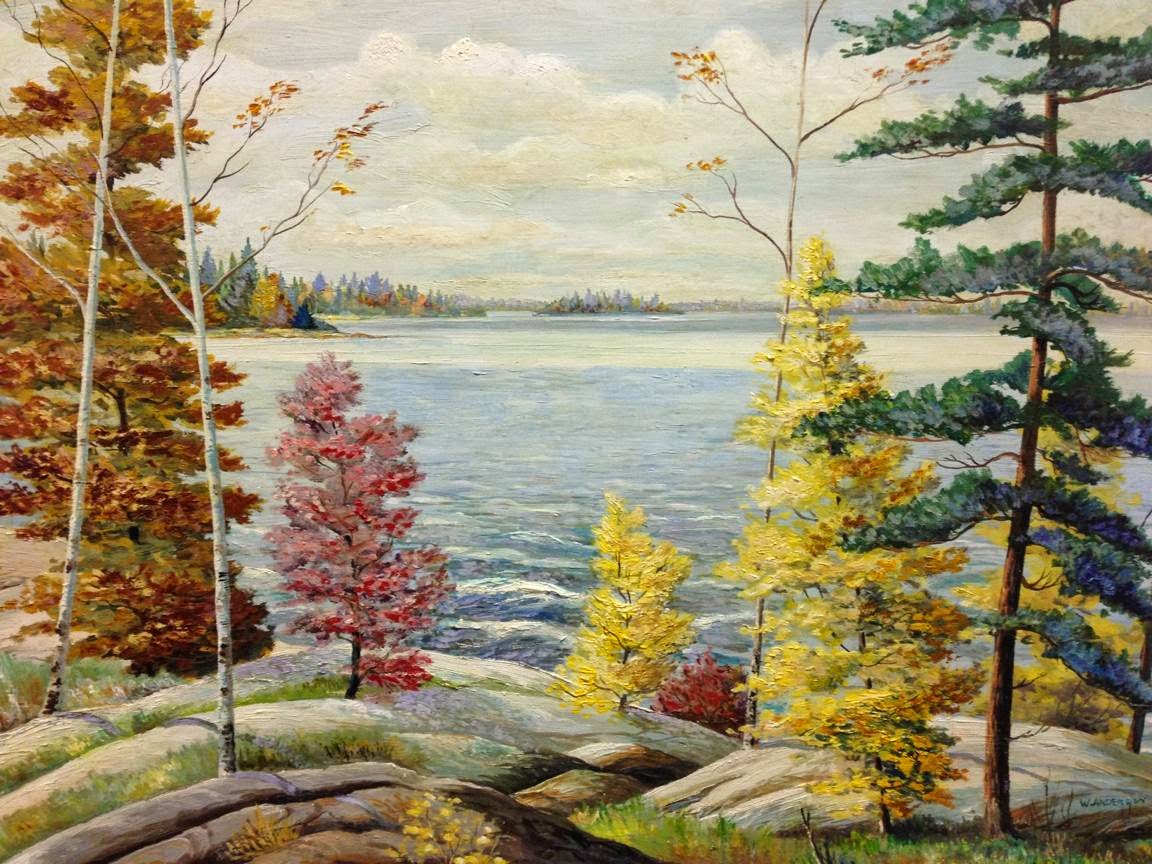
Two of my favourite paintings by William Anderson, the legendary woodsman, painter who was also a barber who had his shop at the south corner of the former Patterson Hotel.


BRACEBRIDGE SKETCHES REVISITED - THE TOWN I REMEMBER, AND STORIES FOR SHARING IN CONTEMPORARY TIMES -

MY BRACEBRIDGE HAD NOTHING AT ALL, TO DO WITH BEING GREAT OR "GREATNESS" - THERE WAS NOTHING INADEQUATE WITH BEING ORDINARY

     My wife knows that I will be writing something or other, one minute before I finally keel over, and cease to be considered at-one with the living. I write because it makes me feel good, and maybe it makes you feel good as well. And seeing as I don't smoke, and I quit drinking a long time ago, and the fact I no longer play hockey, baseball or golf regularly, I feel it's not such a bad thing really, to be addicted to self expression. Of course, some of my enemies and literary critics feel differently. My self imposed retirement, as a blogger, lasted exactly one day. Suzanne warned me this would happen, when I told her on Sunday, I needed a break from Gravenhurst politics. Somehow, like a leaky basement, no matter how much I sealed it up, the water of dissension kept seeping in, and getting my slippers wet. I hate having wet feet. As a kid, we couldn't afford to buy new boots every time I got a hole in them, (which was frequent) so I learned to live with soggy socks, and wrinkled skin. In school, you could follow me from class to class, because of my tell-tale footprints in the hall. This is one part of history I do not wish to re-visit. I honestly needed a break from the pre-occupation with Gravenhurst, as the backdrop for everything we do here, and there, in Muskoka. I still wanted to write, just not about Gravenhurst, at least until after the coming election; because it seemed impossible to get through a blog, that had nothing at all to do with municipal governance, without offering my latest critique. As I have kept the door open, just in case I decide, at the last minute, to run for election, this coming October, I knew it was unethical, at least in my mind, to continue writing; what always seemed to have a political vein, however thin it emerged, each day, from the dark mass of black copy, on a starkly white screen. When it starts percolating up from a blog about antiques, gosh, it's time to move away from the fire.
     Let's be clear about this curmudgeon writer, and this newly revamped blog, which has now reverted back to a purpose, and general interest, to reflect more clearly, what I was writing about back in the early years of the 1990's; right through to the dawn of the new century. My published column then, in a Sunday paper, known as "The Muskoka Advance," was entitled "Bracebridge Sketches," and it was one of my favorites. I've had dozens of published columns, on a wide variety of subjects, up to and including the present, so to remember these sketches as a highlight, means I must have enjoyed writing them. For these blogs, under this banner, I want to make it clear, that I am not following a script, and I have no support, that I know of, from any other historians in the region, many who think of me as a sort of rogue element. I don't belong to any political party, or any fraternal or service club, even any sports association, that would or could influence my opinions on any number of subjects. I am environmentally sensitive but I am not a fanatic. I am a cat owner. How radical can one get, having two cats on your lap, while writing a blog? I don't own even a sliver of property in Bracebridge, so I can't use this blog to advance myself for Bracebridge Council, in the upcoming municipal election; and as far as local politics, I care but, well, I live in a neighboring municipality. And if you think that being a long-time Gravenhurst citizen should limit my capabilities, to comment on Bracebridge history, I should note that I was manager of both Woodchester Villa and Museum, and the Bracebridge Sports Hall of Fame, as well as the author of three Bracebridge related histories, all while living here in tropics of south Muskoka. So don't let my location lead you to believe, I have lesser interest in my former hometown. It's just not true, and I will prove it, over the course of the next year.
     I told my wife and business partner Suzanne, that I wanted to move back to Bracebridge, for an intensive one year writing jag. Well, its a little bit more involved than just re-locating for a year. I actually wanted to spend time at each of the places I have lived, in the past, in order to complete a more thorough retrospective of local history, as I actually lived it! For me that would mean a stay at 129 Alice Street, the former apartment we lived in, up on Hunts Hill (not Huntsville), the former home of Dr. Peter McGibbon, on Manitoba Street, a cottage on Alport Bay, at the end of Beaumont Drive, a Victorian era home, located at the bottom of Tanbark Hill, on what used to be known as Ontario Street, in the former Marrin House, on the corner of Quebec and Kimberly, and the former Herald-Gazette building, at 27 Dominion Street, where I seemed to live while editing papers, into the wee hours, for Muskoka Publication.
    As we are business owners here in Gravenhurst, and have a comfortable little abode we call Birch Hollow, a few blocks away, Suzanne gave me that look of contempt that means, end of discussion; it's not going to happen. So I guess memory and frequent visits will have to suffice, at least for now. But I would really get a kick out of re-visiting all these places again, including Woodchester Villa, which became our second home, when Suzanne and I managed the museum prior to 1990; both Andrew and Robert spent a lot of time playing on the hillside property, and were participants in every program we operated on the historic site, from concerts to the annual strawberry socials. I would love to spend some time at Woodchester as well, because it was where I used to retreat, to write; because it was such an inspiring, spirited place. In fact, I used to sit in the office once used by Henry Bird Sr. himself, overlooking the woollen mill he founded, and built on the upper bank of the Muskoka River, above the cataract of the Bracebridge Falls.
     I am a big fan of Muskoka history, and I have been writing about Bracebridge heritage since 1977, an interest I have continued to pursue with great interest, up to and including the present. Most recently, however, I have found myself becoming weary of local politics, and feeling angry more and more each day, about what I believe are its inefficiencies, and the status quo that seems more the case of reckless endangerment, in the contemporary sense, than creating the flexible dynamic to meet the challenges of the future. I can not say the same about Bracebridge, because I have distanced myself from their brand of politics in recent years. Point is, I did not re-invent Bracebridge Sketches to use it as a political platform, from which to pick on local town council. I no longer live in Bracebridge, and municipal politics must be handled by constituents; not a southern-region historian, butting into the affairs of a former hometown. And to be honest, writing about politics is like carrying an anchor around your neck, and trying to do "the twist". I have never found political critiques of particular interest anyway. As my mother Merle used to say, "Teddy Currie, you get worked up about nothing!" Well, she was half right. Some things are hard to get past if you care about your home region. When I tried to explain the negative realities, of moving the high school out of the centre of town, it was as if I was being blasphemous. When I warned local politicians about moving the town hall, out of the heart of the community, it was the same feeling; as if by objecting, I was cursing the town's future prosperity. Selling off Jubilee Park, and relocating the town's baseball diamonds? It was as if I was the one person who could, with such unharnessed dissension, cloud over the most sunny and bright Muskoka day. It is of little consolation then, to hear the same arguments as I wrote, and expressed in editorials, and in person, during the early years of this new century, coming back in modern day critiques, about decentralization of town facilities; that seems now, as rumor, to be the cause of some of its current economic woes.
    I know why these moves occurred, and what made them seem so perfect, to the obviously positive growth patterns, developing at the time. The one thing they, the enablers, couldn't accept however, was that Muskoka's number one industry is tourism; just as it has been for well more than a century. I believe the movers and shakers thought they could change that economic reality, like thousands of movers and shakers before them. Unfortunately, they changed their focus, and tourism began to be more of a "means to an end," thing, than the most important industry to the welfare of the entire district. The town hall didn't need to be moved to the outskirts, of the urban area, and the new recreation centre could have been built closer to the heart of the town, allowing students to visit local businesses on foot, without requiring taxi service to get there. Of course this distance has had an impact on the economic well being of certain businesses. And town councillors knew this would happen, but were willing to take a chance. They changed history, but not necessarily for the better.
     This is not going to be a political column, because it doesn't need to be, in order to relate a story. This is a promotional collection of stories, that hopefully, will remind readers, who have some stake in Bracebridge, past or present, that it was a positive place of good neighbors once, and remains thus, if one was to take a close look at what makes a hometown a living, breathing, interacting entity. I happen to like its commonplaces, and I intend to explore these characteristics, that inspired me to think of the town as a "great place," to have invested our family future.....when we arrived in Muskoka as urban refugees back in the mid 1960's.

     A few months ago, I read about a group of well-meaning Bracebridge citizens, embarking on a campaign to restore Bracebridge's greatness. If memory serves, and it doesn't always, these days, the group had begun a Facebook initiative, to draw attention, to some of the actual, but mostly perceived deficiencies, being faced by contemporary Bracebridge. I think there was some attention directed toward the main street business community, and the large number of retail vacancies. There were several critiques offered, suggesting that the mature community, may not have been doing as much, as they could, to reverse the trend of negativity. As I hate the idea that us old farts, might in some way, be blamed for being so set in our ways, as to not be able to detect a fresh cup of coffee, from what is cold, and from the day before, I found myself getting perturbed the more I read. The folks who were making the play for a more positive, ambitious, aggressive Bracebridge, while probably very well meaning from the get-go, were making the fundamental error, we historians come upon constantly; let's look for fault somewhere else, find someone else to blame, and throw out all kinds of hypothetical situations, to make the present-tense arguments seem of sensible proportion. When in reality, those who are constructing these inroads, have done so, without thinking it necessary, and important, to talk with those who possess information they need. An historian for example. If a building's foundation has a destabalizing crack, nothing you repair at the top, is going to make any difference to the security of the structure. Maybe it will look more attractive, when it tips over and crashes to the ground. So if any one wants to get to the bottom of a contemporary issue, that's causing some trouble, the best advice is to look down, or look back, as a first step of restoration.
     As I was in the middle of a substantial research project, when these first few articles began hitting the local press, a few months ago, I decided to let it play out for awhile, before, as they say, sticking my oar in to the fray. My first objection, was the suggestion that Bracebridge had in any way, at any time, been considered a "great" community. We have, since the earliest days of settlement, experienced "great" events, and had some citizens accomplish "great" things, including local sports teams, and athletes, but take it from an historian, who has studied Bracebridge, backwards and forwards, since the late 1970's, "great" is not a word I would use to describe my former hometown. I live in Gravenhurst, and I wouldn't describe it as "great" now, or in the past, but that doesn't mean there haven't been "great" moments, and "greatness" by definition, when looking back at history, or describing certain contemporary accomplishments. So I wanted to fire off a letter to the editor, of the Bracebridge Examiner, but I thought it would be too difficult, in a three or four paragraph retort, to explain why "greatness" isn't an attainable goal for any community, past, present or future. What is attainable, for those wishing to look past the obvious, is an acquired understanding of what makes any community dynamic, accommodating, neighborly, progressive, positive, and socially, culturally self sustaining. In other words, instead of trying, and failing, to attain each other's standards of greatness, consider instead, the achievement of being the kind of community that looks after itself, by being robustly, and aggressively good neighbors. I'd rather think of Bracebridge truth be known, as the kind and caring community that helped raise me, and thousands of others, than worry about whether it had been "great" once, and suddenly lost its charm, and position of regional domination. Greatness, to the vested interest, tends to only be measured by success, proportional to the profit and loss scenario. Seeing as Bracebridge has survived through many tougher times than the present, I am more likely to think of greatness, in terms of long-term survival; than any adaptation, that would mistakenly deem economic success as the end-all. Having every store-front gainfully occupied, and more industrial and development investment, does not fill all the requirements of "being a great community." I've known many well off communities in the economic sense, but they all had shortfalls and deficiencies. So be careful what you hope for. A greater community, in my mind, is one that sticks together through tough times and profitable ones, but never compromises on matters of common welfare amongst neighbors. I grew up in a small town that despite its limits to growth, cared about those of disadvantage, as much as they enjoyed their blessings. I count myself and my family amongst this number, on both counts.
      Historians look at these things quite differently based on experience. We've watched economic ravages hurt our Muskoka communities in the past, and for someone like me, it goes all the way back to the late 1850's, when isolation was the lead hardship. So I've got a pretty good grasp of the greatness issue, and where that description could, and can now be applied, and considered historically warranted.
     I am not one to deny the younger generation, their opportunity to critique the modern environs, and us oldtimers, (who seem a tad unmovable) and what may be, in their judgement, wrong with the community initiatives, according to their present ambitions. I found somewhat the same in my era, returning to Bracebridge after university. I wanted to earn my place in local history. I was in my early twenties, when I began the work to establish the Bracebridge Historical Society, and was one of the original board members with fine citizens, such as Ralph Melvin, Wayland Drew, and Wendy Wilson. It was responsible, in part, for the eventual establishment of Bracebridge's first museum, known as Woodchester Villa, and I became the youngest non-family member to be editor, of the local legacy publication, "The Herald-Gazette;" and eventually, associate editor of The Muskoka Sun, a colleague of well known Bracebridge historian, Robert Boyer. My son Robert was named after Mr. Boyer, as that was the degree of respect I possessed, for my mentor in local history. As I began working to research the history of Bracebridge, in my early twenties, I had a chance to work closely with many of the town's historical-types, such as Les Tennant, who shared a huge collection of heritage resources, and photographs, who passed away before we could put his history into book-form. I covered, as a reporter / editor, Bracebridge Council, and got to know some of these legends of municipal governance; memories I still cherish to this day. Names of councillors like Russ Crockford, Ralph Melvin, Norm Harkness, Jim Lang, Aubrey Glass, Jim Boyes and Frank Henry, who to me, were soft spoken elected officials, who always, in my way of looking at municipal politics, looked out for all constituents as being important, not just those who owned property or major businesses. There were others, but we'll get to that as I unwind this blog a bit more, down the proverbial road.
     This will not be a politically motivated, or disguised critique of Bracebridge; or for that matter, a daily review of how the municipality does its day to day business. Believe me, you don't have to look too far, to find out just how firmly imprinted I am, on public record, regarding those developments of the past, that I have vehemently opposed. Yes, right to the point of carrying placards in protest, and writing reims of counter-points, regarding the risky direction the town was taking, in its collective thinking about positive growth. At odds, you see, with my appraisal, about what was progressive and economically suitable, for the town, versus what was sensible proportion and truly sustainable growth. I was against moving town hall from Dominion Street, at the centre of town, and I was opposed to selling off Jubilee Park, on Wellington Street. I have volunteered my services to help with the restoration of Woodchester Villa and Museum, in this most recent troubled time for the historic site, but because I'm more outspoken than council desires of their volunteers, my offer has been ignored. No surprise in this regard. It comes with the territory of being opinionated when it conflicts with a municipalities strategy of deployment. I tend to get in the way a lot, even here in Gravenhurst; I'm not wrong with my opinions, but apparently, wrong for making them public. Well, I have no intention of capitulating any time soon. But my work on this newly redeveloped blog, isn't the planking of a new platform, from which to launch sneak attacks at the governance of my former home town. Quite to the contrary. In keeping with the situation, and this latest media initiated discussion, about "making Bracebridge great again," I will offer some historical insights with a contemporary relevance, to hopefully, after the next year, infill some information, citizen activists, of the younger generation, have over-looked, about what truly makes a hometown exceptional, and a caring, responsive neighborhood, for all constituents, all of the time. But what I'm going to reveal, over time, is what you probably already know anyway. You can't fix what seems wonky today, without taking a careful look back in time, to see how this community developed, as compared to other towns, villages, and hamlets, in the District. While it may not seem that Bracebridge is so much different, socially and culturally, from the other major towns of Muskoka, I'd like to prove the exact opposite; each is unique although we share one of the most beautiful lakelands in the world. The mistake the local media makes, I suppose because of economic realities, is to treat the three main towns as if they are roughly the same, in character; such that sharing Huntsville's news with Gravenhurst, and Bracebrige would make perfect sense. I'm sorry to rain on their parade, but they don't know the regional history very well, if they truly believe, that because you revise a weekly newspaper, to accommodate a wider regional coverage, you can erase that imbedded sense of competition, that is as deep here, as the forest is tall. Gravenhurst citizens have very little interest in what is going on in Huntsville, of a routine nature, and as tradition would have it, Gravenhurst and Bracebridge have a boundary line in common, but honestly, very little else. While the media might assume that it has cleverly minimized that imbedded, traditional sense of competition between the towns, that began from the first shanties carved into the Muskoka woodlands, it is nothing more than an accepted strategy spun around the boardroom table; one that would sink like a stone, if the communities themselves could, if opportunity presented, go back to the old days, of having their own unique publications serving their news, feature and social requirements.
     While I would probably work for free, if given a chance to edit a local newspaper once again, I realize this blog will have to suffice, at least in terms of what I'd like to have at my disposal. It will be a collection of stories about the great days I had being associated with Bracebridge, and what you may not know about the town; because the stories I spin are not ones you're going to read in locally published books. Sometimes they're a little "out there," and "seem like fiction," and a few are, by definition, "a little risque," if you're a conservative thinker, and prefer local hometown history to be bland and uninteresting. This blog will either relate to new readers, as a breath of fresh Muskoka air, or be considered nothing more, than a work of strange, disturbing fiction. Or, on the other hand, it might serve-up a history lesson, that provokes the conservative amongst us; pissing off those, for self serving purposes, who have written about history only to suit their own interests and agenda. I will no doubt relate some stories, that refute the facts about major events, and occurrences, previously set to print. Of this, I offer a preamble apology. I'm predictably unpredictable, in this regard, and I don't write columns in advance. I may take my laptop to an interesting portal on Manitoba Street, like when I holed-up to watch and learn as a kid, possibly where I can still see the famous clock tower of the old federal building, that kept me on time, throughout my young life, and early adulthood. It will be spontaneous but always reverent of the good life I had, and my family experienced, for a lot of decades, starting in the late winter of 1966. The year hometown kid, Roger Crozier, won the Conn Smythe Trophy, for his playoff performance against Montreal. Detroit didn't win the cup that year, but they gave Roger Crozier his own day, a main street parade, and his school chum, Paul Rimstead, one of this country's finest columnists, wrote all about it; and about the times he and Roger used to cut school, holing-up to play pool at Joe's Billiards, on the Queen's Hill, just north of the Patterson Hotel (former Queen's Hotel on Manitoba Street). TALK ABOUT STORIES.
     There are some of my historical cronies who will welcome another opinion on the chronicle of local history, and there will be others cringing at the idea, I might restore my neighborhood nostalgia again, writing about those fascinating old corner stores, like Black's Variety, and Bamford's up on Hunt's Hill, and remember cronies like Fred "Bing" Crosby, and sports fanatic, Randy Carswell, who both were celebrities of our town, without having money, power, or social standing. It was like that back then. We had greeters and well wishers all over the place, and boy oh boy, did it ever have an impact on the quantity of goodwill floating about. This is what I consider our social / cultural heritage, that isn't up to being included in larger, glossy covered town histories. But believe me, these stories are important.
     Please join me again tomorrow, to begin this adventure in earnest.

FROM MY OWN BRACEBRIDGE HISTORY ARCHIVES


What I learned from author-historian Wayland Drew

I believe it was the winter of 1978. The first meeting of the soon-to-be Bracebridge Historical Society, was unofficially held at the home of well known Canadian author Wayland Drew. It was a meeting between a citizen, this writer, who was interested in preserving an historic building in the Town of Bracebridge, (an octagonal home constructed in the 1880’s by former woolen mill owner Henry Bird)……and the second party, at the informal meeting, Mr. Drew, was in my mind, a writer-historian of considerable national reputation, (eg. the landmark text entitled, “Superior, The Haunted Shore.”) That’s correct. I’m so very proud to write that Wayland and I made up the first full planning meeting of the soon to be elected historical society. As an aspiring writer, I was in awe that he would give me a private audience to discuss the possibility of forming a local historical society, to implement a conservation strategy to save Woodchester Villa (the Bird House). I had been attempting to drum up support for a citizen-driven initiative to create a community museum, and Wayland must have thought I had at least a spark of credibility to follow through on the project. He called me over to his house for a discussion about all the possibilities of saving this particular Victorian era home. We worked well together and our plans merged to give rise to a new historical preservation group, and eventually, with a huge commitment of citizen involvement, a newly restored town museum would open on that pinnacle of land above the cataract of Bracebridge Falls. My first position was “Recording Secretary,” which I conducted poorly, but rebounded some years later as President and then site manager. Much of the credit goes to Wayland for negotiating so well for the Historical Society generally, and always being its ambassador.
This editorial segment is not a biographical study of my writer-associate, Wayland Drew, or a re-telling of the work of the Bracebridge Historical Society. There is a story about Wayland I have often repeated in environmental presentations ever since, about the importance of listening and learning from expertise. And while we might all believe we’re the best experts we’ve ever met, I was to learn up close and personal how little I knew about the bigger picture of conservation. This is a story that’s of great importance to this on-line inventory of blog editorials because it is at the root of every entry in one way or another.
Several years into the museum’s operation, a situation arose with the town about the necessity of removing numerous large trees lining the old laneway at the front of Woodchester. If memory serves, the problem was that if any emergency vehicle had required access to the building, via this riverside route, the narrow artery would not allow safe, unobstructed passage particularly for the larger fire-fighting equipment. It probably was the case as well that the large border trees would cause great difficulty for snow removal, important for emergency vehicle access as well. The town public works department had recommended the removal of those trees that limited the width of the driveway, and the recommendation did not sit well with Wayland and several others. At the time Wayland was no longer a director of the Historical Society, but was part of a delegation that attended to object to the cutting.
I sat as a voting director.
As I recall now, Wayland made a sensible, balanced, gentle argument to spare the trees by making accommodations with a rear parking area, offering adequate clearance for the larger emergency vehicles. I don’t remember all the details of that lengthy afternoon meeting, except that I acted as the part of “ass” very well. I shot down Wayland without mercy, suggesting that emergency services access to all corners of the site greatly outweighed the scenic splendor of a few large evergreens to be expended. He wasn’t against making provisions for emergency services in numerous other ways, including carving out some of the embankment, all alternatives being well thought out and workable I might add. He was adamant the trees, having been there for a good part of a century, and being an important part of the Woodchester and Muskoka ambience, deserved to be spared the teeth of the industrial strength chainsaw.
I have no idea now what really generated my opposition to alternatives that would spare the trees. I know it was largely a case of ignorance on my part, and a general immaturity, that I would ever have challenged someone who made such a sensible, researched, community minded presentation. I can still recall the shocked look on his face when I cast forward a resounding reprimand for even thinking about any compromise that would limit entrance to the property; and that afterall, “they’re just trees…..they’ll grow back.” I had shown great disrespect to a person who I had always admired in both historical preservation and conservation of the environment. I voted against the conservation of those trees but the good news is my position wasn’t on the winning side. I believe a compromise was reached and although some trees may have been removed, (I don’t remember exactly the reduced cull), Wayland’s argument made sense to the group at large. Although Wayland never said a word about my indifference to the matter of Woodchester’s natural heritage, he didn’t have to say anything at all. It was an awkwardness in our conservations from that point on but always the result of the unfortunate weight of my own conscience. I should have been wise enough to realize that if Wayland Drew had thought it important enough to interrupt his busy day to discuss several trees in peril, it must be a landmark situation deserving the most clear thinking appraisal in response.
A short time before Wayland passed away, after a lengthy illness, we found ourselves both sitting comfortably in the cool shade of a perfect summer day, during a writer’s gathering held ironically at Woodchester Villa. It was a modest, unplanned homecoming to Woodchester, dealing with writing this time, not history, with nary a chainsaw rattle within ear-shot. I took a turn at the podium to read one of my short stories and following the presentation, Wayland left his seat to congratulate me on the subject of my recitation, a fellow writer, (and student from Bracebridge High School) named Paul Rimstead, well known Toronto Sun columnist who had died a short while earlier. It seemed Wayland and I agreed upon the great talent of the “Rimmer,” and that the world would be disadvantaged without his daily barbs and insights.
At the time Wayland knew his life was being seriously shortened, and as it turned out this was the last time I would talk to this amazing, talented gentleman. I can remember wanting so badly to offer a sincere, belated apology for the great tree-debate of once but foolish pride got in the path of an honest, heartfelt regret. I let him walk away without clearing my conscience about a ill-conceived, childish stubbornness that very nearly cost this beautiful tree-lined property even more of its historic, natural charm.
I have attempted many times since Wayland’s death to make amends with the issue, as if expended ink can make up for what I didn’t accomplish in person. Wayland’s passionate appeal for environmental conservation did however, over so many decades of re-consideration, generate within this writer the first and enduring interest to get involved, and speak out about the reckless destruction of forests, the infilling of wetlands, and the damning realities of urban sprawl across the entire Muskoka hinterland.
I wish I had listened more patiently to the sage advisories of the good Mr. Drew. He wasn’t wrong, and his concerns were just as valid then as today. I seldom if ever visit a Muskoka woodland for a hike, that I don’t tribute the experience and enjoyment, in some way, to the inspiration I received from a true friend of Muskoka. My only wish, as a writer, is that I could one day be as effective and enlightened an author, as the man who challenged me to take up the pen in the first place.
Thank you Wayland Drew. The experiences you shared have not been forgotten, the lessons you taught have not diminished; your passion to protect the environment, is the passion now carried forth by your students.

Sunday, June 1, 2014

Alas It Is Time For My Retirement; It Has Been A Long Haul and Oh The Things I've Seen and Written About


This sums of life and times.


BREAKING NEWS; I HAVE, ON SOME FAMILY URGING, DECIDED TO CHANGE OVER TO A BRACEBRIDGE AND MUSKOKA THEMED BLOG FOR THE NEXT SIX MONTHS UNTIL THE MUNICIPAL ELECTION IS COMPLETE. THESE STORIES WILL BE OF THE NON-POLITCAL, NON-ANTIQUE VARIETY BUT WILL BE A THROW BACK TO WHAT BRACEBRIDGE AND MUSKOKA MEANT TO THIS WRITER IN THE 1960S TO 1980S. YOU CAN VIEW THESE BLOGS DAILY ONCE AGAIN BUT I WILL PURPOSELY KEEP GRAVENHURST AND LOCAL POLITICS OUT OF THE MIX. THANKS. THE BLOG NAME HAS BEEN CHANGED TO "BRACEBRIDGE SKETCHES"


ALAS, IT'S TIME FOR MY RETIREMENT; JUST IN CASE I GET A POLITICAL URGE -

BETWEEN NOW AND THE LAST DAY TO REGISTER FOR THIS FALL'S MUNICIPAL VOTE

     THE FACT THE LINE-UP OF COUNCIL-HOPEFULS, SO FAR, REGISTERED FOR THE UPCOMING MUNICIPAL ELECTION, IS ABOUT AS STATUS QUO, AS YOU CAN GET, WITHOUT BEING CLINICALLY DEAD, SHOULD MAKE ALL OF US NERVOUS IN THIS MUNICIPALITY. WE NEED SOME CHANGE AT THE TOP, ALTHOUGH THE POLITICALLY MOTIVATED ENABLERS, OF WHICH THERE ARE MANY, SEEM TO BE CONTENT TO MAINTAIN THE SAME OLD-SAME OLD, FOR WHATEVER REASON. IT'S LIKE THE DAYS IN UPPER CANADA, WHEN THE FAMILY COMPACT RULED THE ROOST. THERE IS ABSOLUTELY NO EXCITEMENT ATTACHED TO THIS ELECTION, AND FOR ALL INTENTS AND PURPOSES, IT SEEMS A WASTE OF MONEY TO EVEN RUN A PUBLIC VOTE HERE. IT'S OUR DEMOCRATIC RIGHT TO VOTE, BUT A LARGE PERCENTAGE COULDN'T CARE LESS. I EXPECT THE VOTE TO ONCE AGAIN, BE A LOW PERCENTAGE OF CONSTITUENTS, MOST WHO SIMPLY DON'T APPRECIATE WHAT'S AT RISK HERE. WELL, THERE'S A BIG RISK, AND ONE YEAR, NOT SO LONG AGO, A GROUP OF COUNCILLORS TRIED TO SELL OFF AN IMPORTANT WETLAND, TO RAISE A FEW BUCKS TO BUY A NEW TOWN HALL. THEY FOUND ANOTHER WAY TO FINANCE TOWN HALL. US! I'D LIKE TO SEE MEMBERS OF THE COTTAGER ASSOCIATION, SHOW SOME INTEREST IN THIS ELECTION, POSSIBLY BY RUNNING A CANDIDATE OR TWO, BECAUSE BEFORE LONG, THERE ARE GOING TO BE ISSUES SURROUNDING THE POTENTIAL SALE, OF THE FORMER MUSKOKA CENTRE PROPERTY, AND FROM MY MUNICIPAL COUNCIL KNOWLEDGE, DATING BACK TO THE LATE 1970'S, A WISER AND MORE EXPERIENCED COUNCIL IS A REQUIREMENT. IF WE DON'T WANT ANOTHER UGLY SITUATION, IN COTTAGE COUNTRY, BETWEEN LOCALS AND COTTAGERS, LIKE WHAT OCCURRED BETWEEN THE MUSKOKA LAKES ASSOCIATION AND THE TOWNSHIP OF MUSKOKA LAKES, BACK IN THE EARLY 1980'S, AND IN THE TOWNSHIPS OF THE ARCHIPELAGO, SOUTH OF PARRY SOUND, BEFORE THAT, IT'S WISE FOR THE MUSKOKA BAY ASSOCIATION TO SERIOUSLY CONSIDER THE CONFIGURATION OF THE COMING FOUR YEAR COUNCIL. I'M NOT SUGGESTING THEY RUN A SLATE OF CANDIDATES, BUT IF THEY WANT THEIR CONCERNS ADDRESSED AT THE HIGHEST LEVEL, THEN THEY SHOULD MAKE SURE CANDIDATES ARE IN PLACE TO REPRESENT THOSE ISSUES. IT'S BEEN DONE BEFORE, IN BOTH AREAS MENTIONED ABOVE, AND IT WORKED. A LITTLE TENSE AT FIRST, BUT IT DID DEVELOP A LOT BETTER RELATIONSHIP BETWEEN THE LAKES ASSOCIATION AND THE MUNICIPALITY.
     I HAVE SUGGESTED TO DISGRUNTLED CITIZENS, REPRESENTING GROUPS IN THIS COMMUNITY, WHO HAVE FELT THEIR CONCERNS HAVE NOT BEEN MET BY COUNCIL, FOLLOWING DELEGATIONS, SHOULD ALSO CONSIDER RUNNING A CANDIDATE, TO, AS THEY SAY, FIGHT FROM THE INSIDE OUT. FOR ME, I DON'T LIKE THE WAY THE OPERA HOUSE IS BEING RUN AND I WOULD MAKE IT A PRIORITY, AS A CANDIDATE, AND AN ELECTED TOWN COUNCILLOR, TO WORK WITHIN, TO BANG OUT SOME OF THE DINTS. I'VE GOT QUITE A FEW MEMBERS OF THE PUBLIC, WHO WOULD LIKE TO REPAIR THE OPERA HOUSE AS WELL. SO I'VE SUGGESTED THEY COULD RUN TOO, AND WE'LL MAKE A PARTY OUT OF IT! PARTY? GET IT? WE COULD CALL OURSELVES THE "FREE THE OPERA HOUSE PARTY."
     AS FOR RETIRING, WELL FOLKS, IT'S NECESSARY. AS I HAVE PROMISED, AND I CAN'T GO BACK ON IT, I WON'T USE MY BLOG TO FURTHER POLITICAL ASPIRATIONS. MINE, OR FOR ANY ONE ELSE. IT'S NOT FAIR. IT WOULDN'T BE FAIR. I'VE GOT A GOOD READERSHIP, BUT I CAN'T PLAY GAMES JUST TO WIN A VOTE. IF I DO RUN, IT WILL BE WITHOUT FANFARE OR ADVERTISING. THAT'S CORRECT. A NO EXPENSE CAMPAIGN. MINE WOULD BE A MAINSTREET CAMPAIGN, THE OLD FASHIONED WAY, WITH HANDSHAKES, KISSING BABIES AND CONVERSATION. VERSUS BILLBOARDS AND UGLY SIGNAGE CONTAMINATING A PICTURESQUE REGION. RIGHT NOW, I DON'T HAVE ANY ASPIRATIONS TO ENTER THE RACE. BUT I DON'T WANT TO SEE ACCLAMATIONS IN GRAVENHURST. I MAY HAVE TO RUN FOR MAYOR TO STOP IT FROM HAPPENING. ANY ACCLAMATION REFLECTS BADLY ON THE COMMUNITY, AND SHOWS THAT APATHY HAS NOT ONLY BEEN SEEDED, BUT HAS BECOME DEEPLY ROOTED. I AM SUPER DISAPPOINTED SO FAR, IN THE CANDIDATE FIELD, AND HONESTLY, TO RUN A GOOD CAMPAIGN, THOSE WHO INTEND TO SEEK ELECTION, SHOULD HAVE DECLARED BY NOW. THAT IS, IF THEY WANT TO MEET THE CONSTITUENTS, UP CLOSE AND PERSONAL, TO SEEK THEIR SUPPORT IN THE OCTOBER ELECTION. WHY ARE POTENTIAL CANDIDATES HOLDING BACK? ARE THEY OF THE OPINION EVERYTHING IS FINE HERE? ARE THEY FED-UP AND JUST DON'T CARE ANY MORE, WHO RUNS TOWN HALL? I BELIEVE WE SHOULD HAVE THREE QUARTERS OF THE CANDIDATES DECLARED BY NOW, AND WHAT I SENSE, IS THAT MOST PEOPLE HAVE JUST THROWN IN THE TOWEL, AND DECIDED THAT THERE ARE MORE IMPORTANT THINGS IN LIFE. I TEND TO AGREE WITH THESE PEOPLE. BUT AS IT IS OUR FAMILY'S HOMETOWN, AND I FEEL STRONGLY THAT OUR MUNICIPAL COUNCIL IS NOT DOING A GOOD JOB, AND DOESN'T DESERVE ANOTHER FOUR YEAR TERM, AS IS, I DON'T BELIEVE I CAN TURN AWAY ENTIRELY; THOUGH I MAY HAVE TO RUN UNDER PROTEST, JUST TO MAKE A RACE OUT OF IT. FOR GOD'S SAKES FOLKS, PLEASE STEP UP. IF YOU HAVE COMPLAINED ABOUT THE WAY THE TOWN IS BEING RUN, THEN THROW YOUR HAT INTO THE RING. IF YOU CURSED THE TOWN, WHEN YOU HAD TO NAVIGATE, AT GREAT RISK, THE CRATER FILLED ROADS THIS PAST WINTER, THAT DIDN'T HAVE TO BE THIS WAY, THEN CONSIDER TAKING THE PLUNGE, SO THAT YOU CAN INFLUENCE THE NEXT COUNCIL, TO SMARTEN UP.
     BY RETIRING THE BLOG, AT LEAST FOR THE DURATION OF THIS MUNICIPAL ELECTION PERIOD, I CAN WORK WITH CANDIDATES (WHO ASK FOR HELP), AND I'M OPEN TO JUST ABOUT ANYTHING THAT'S LEGAL, TO LEND A HAND TO GOOD PEOPLE, WHO HAVE AN INTEREST IN PULLING THIS TOWN OUT OF ITS PRESENT STALEMATE. OF COURSE, I HAVE THIS CONFIDENCE IN MYSELF, THAT I CAN WORK WITH JUST ABOUT ANYBODY, WHICH MAY GET A REAL TEST THIS CAMPAIGN; BUT MY TRACK RECORD IS PRETTY GOOD IN THIS REGARD. THE PROBLEM IN OUR TOWN, IS THAT THE ELECTION IS SHAPING UP TO BE NOTHING MORE THAN A POPULARITY CONTEST, AND SOME OF THESE CANDIDATES KNOW, ALL THEY HAVE TO DO IS SHOW UP ON THE BALLOT, AND THE REST IS COUNCIL HISTORY. THE CHAMBER OF COMMERCE WILL UNDOUBTEDLY RUN ANOTHER ALL CANDIDATES MEETING, LIKE THEY DID FOUR YEARS AGO, WHERE THE PUBLIC WAS, FOR ALL INTENTS AND PURPOSES, MUZZLED FROM ASKING QUESTIONS RAISED FROM THE FLOOR. QUESTIONS HAD TO BE SUBMITTED IN ADVANCE, AND WERE SCREENED, AND THE ONES APPROVED MADE IT TO THE FLOOR. NOW THERE'S AN EXERCISE IN DEMOCRACY FOR YOU. IT'S WRONG, AND THE COUNCIL HOPEFULS KNOW IT'S WRONG, AND THEY SHOULD BOYCOTT THE EVENT, IF THE SAME PROTOCOLS ARE FOLLOWED. QUESTIONS NEED TO BE ALLOWED FROM THE FLOOR, AND THERE SHOULD BE A SEPARATE NIGHT FOR MAYORAL CANDIDATES. USING TIME RESTRAINTS AS AN EXCUSE, FOR CUTTING DOWN ON THE NUMBER OF QUESTIONS, IS JUST SILLY ASS NO MATTER HOW YOU LOOK AT IT.
     SINCE I BEGAN THIS BLOG, PART TIME, QUITE A FEW YEARS BACK, I HAVE TAKEN ISSUE WITH WHAT I BELIEVED WAS, AND STILL IS TODAY, A WEAK AND INADEQUATE COUNCIL. I MAKE NO APOLOGY FOR STATING THIS, AS I HAVE KNOWN MANY GOOD AND RESPONSIVE COUNCILS, THROUGHOUT THE DISTRICT OF MUSKOKA, IN THE PAST; AND WORKED AS A NEWS EDITOR, WITH MANY FORMER MAYORS, COUNCILLORS, AND DISTRICT CHAIRMEN. I HAVE KNOWN SOME FINE COMMUNITY LEADERS, AND YES, I COULD WRITE A BOOK ABOUT IT. I DON'T FEEL THE SAME ABOUT THIS PRESENT COUNCIL, AND FROM THE GRUMBLING GOING ON THE STREET, CONSTITUENTS, AS THEY SAY, SHOULD POOP OR GET OFF THE POT. YOU CAN'T COMPLAIN AND THEN REFUSE TO GET INVOLVED, WHEN CHANGE IS POSSIBLE AND ATTAINABLE. IT'S TRUE THAT THERE ARE PEOPLE OUT THERE, WHO THINK THAT THIS COUNCIL IS THE BEST WE'VE EVER HAD. I WOULD CHALLENGE THEM THEN, TO PROVE IT TO THE HISTORIAN. FEEL FREE. I LIKE A GOOD, SHORT DISCUSSION.

ON THE LESS POLITICAL SIDE - A RETIREMENT

     A YEAR AGO, SUZANNE RETIRED AFTER 31 YEARS OF TEACHING. SHE'D FINALLY HAD ENOUGH. SHE WAS OKAY WITH THE KIDS, BUT NOT WITH THE GOVERNANCE OF THE BOARD, OR HOW THE PROVINCE HANDLES EDUCATION STANDARDS. SHE WAS A CONSUMMATE TEACHER, AND I CAN'T TELL YOU HOW MANY KIDS SHE MOTHERED IN THOSE THIRTY PLUS YEARS. WE USED TO HAVE KIDS CALLING HERE ALL THE TIME, AND SHE NEVER TURNED ONE OF THEM AWAY, OR WAS INSENSITIVE ABOUT THE REASONS THEY WERE SEEKING HER ASSISTANCE. IT'S STILL HAPPENING. FORMER STUDENTS ARE STILL CALLING HERE, AND DROPPING INTO THE ANTIQUE SHOP FOR A VISIT. WHICH HAS MADE RETIREMENT A LITTLE EASIER, BECAUSE YOU CAN'T SPEND THREE DECADES DOING SOMETHING YOU LOVE, AND THEN DROP IT ENTIRELY WITHOUT SOME CONSEQUENCE. BUT SHE HAS TURNED HER FRUSTRATION WITH THE BOARD OF EDUCATION, AND THE PROVINCE, INTO A MORE USEFUL ENTERPRISE, BY RUNNING HER OWN ANTIQUE AND COLLECTABLE BUSINESS; WHICH DOES OCCUPY MOST OF HER TIME.
     I HAD ALSO PLANNED TO RETIRE FROM THE BLOG, THAT ADMITTEDLY, I HAVE HAD SO MUCH FUN WITH, FOR THESE PAST FEW YEARS, ATTAINING OVER 220,000 VIEWS. NOT TO SHABBY FOR A SMALL TOWN WRITER, TRYING TO MAKE A FEW POINTS ABOUT THIS AND THAT. AS YOU KNOW, FROM READING THIS BLOG, I HAVE BEEN WRITING FOR PUBLICATION SINCE THE LATE 1970'S. I'VE APPEARED IN MORE THAN A DOZEN PUBLICATIONS, AND I WAS ONCE TRANSLATED INTO ICELANDIC, AND PUBLISHED IN A HERITAGE MAGAZINE IN THAT COUNTRY. I'VE FOUGHT WITH PUBLISHERS, AND PULLED MY COLUMNS NUMEROUS TIMES, WHEN EDITORS GOT SMART-ASS, AND TRIED TO LIMIT MY COPY, AND ADJUST MY STORY-LINE. ONE DID AND WHAT WAS SUPPOSED TO BE A LONG TERM COMMITMENT, WAS OVER AFTER THE FIRST COLUMN, BECAUSE OF A RECKLESS JOB OF EDITING, RUINED A PERFECTLY GOOD STORY AS IT WAS SUBMITTED. IN SHORT, I'VE BEEN A PAIN IN THE ASS TO A LOT OF PUBLISHERS AND EDITORS, AND I'VE ENJOYED EVERY MINUTE OF IT! I WAS AN EDITOR MYSELF, AND I GOT HOSED MANY TIMES BY MY OWN WRITING STAFF. TRUTH BE KNOWN, I ALWAYS PREFERRED TO WRITE MORE THAN EDIT, AND SINCE THE SUMMER OF 1989, I'VE BEEN WRITING FREELANCE, AND ENJOYING THE INDEPENDENCE. I HAD A NUMBER OF TEACHERS, WHO WOULD WRITE ON MY REPORT CARDS, THAT "TEDDY DOESN'T PLAY WELL WITH OTHERS." LET'S JUST SAY, I DIDN'T PUT UP WITH B.S., OR HOGGING OF THE TOYS IN THE SANDBOX. GEEZ, WOULDN'T GRAVENHURST COUNCIL MEETINGS BE INTERESTED WITH A GUY LIKE ME SITTING AT THE TABLE? WE'D NEED A REFEREE AND WHISTLE.
     I'VE WRITTEN ABOUT MY BOYS BEING BORN, AND ABOUT SUZANNE'S PARENTS PASSING AWAY; AND MY OWN, WHICH I HAD THOUGHT ABOUT FOR YEARS, CONSIDERING MY FATHER'S NAME WAS THE SAME AS MY OWN. I WONDERED IF PEOPLE, SEEING THE OBITUARY IN THE PAPER, WOULD THINK IT WAS ME WHO HAD EXPIRED INSTEAD. BUT WRITING YOU SEE, AS IT IS FOR MOST OF THE WRITERS I KNOW, IS A WAY, AT TIMES, OF DOING SOMETHING POSITIVE AND MEANINGFUL, INSTEAD OF EXPENDING A LOT OF ENERGY OF GRIEVING THROUGH BAD FEELINGS AND TEARS. I'VE SAT AT MY OFFICE DESK MANY TIMES, WONDERING HOW I WAS GOING TO PULL OUT OF A FUNK, A DEPRESSION, TO MAKE A COPY DEADLINE; YET ONE THINK ABOUT THE PRINTED WORD. ONE WORDS INSPIRES THE OTHER, AND IT MAY ONLY BE THE IMPRINT OF MY BYLINE AT THE TOP OF THE PAGE. IT HAS ALWAYS BEEN A VEHICLE FOR ME, TO EXPRESS FEELINGS OF JOY AND SORROW, SATISFACTION AND FRUSTRATION. I'VE NEVER LEFT THIS KEYBOARD FEELING THAT I HADN'T RESOLVED MY NEED, FOR THAT DAY, TO EXPRESS WHATEVER EMOTION I HAD BEEN AFFLICTED, HAPPILY OR OTHERWISE. BUT FOLKS, THERE COMES A TIME, WHEN YOU JUST RUN OUT OF THINGS TO WRITE ABOUT, THAT CAN HOLD AN AUDIENCE. I'D RATHER GO OUT ON A HIGH, WITH A STRONG NUMBER OF READERS, THAN POSSIBLY, AT A TIME DOWN THE ROAD, OF HAVING TWENTY OR LESS GUESTS, STICKING WITH ME, MORE OUT OF PITY, OR TO READ MORE OF A SAD, AND GETTING SADDER STORY, THAN BECAUSE I'M WRITING SOMETHING THAT CHALLENGES COMPLACENCY.
     WHEN I TOLD SUZANNE I WAS GOING TO WRITE MY LAST BLOG TODAY, SHE GRABBED THE LAPTOP AND MADE A MOCK THREAT ABOUT TAKING IT AWAY, SO I COULDN'T WRITE ONE AT ALL. IT WAS SUZANNE, YOU SEE, WHO GOT ME BACK WRITING, FOLLOWING AN ANGRY YEAR'S HIATUS, AFTER I HAD LEFT EMPLOYMENT OF THE BRACEBRIDGE EXAMINER, IN THE SUMMER OF 1990. SHE CONVINCED ME TO GIVE IT ANOTHER SHOT, AND IT TURNED OUT TO BE THE BEST ADVICE OF MY LIFE. I BRIDGED THE FIRST ELEVEN YEARS OF MY WRITING CAREER, AND IT'S TAKEN ME ALL THE WAY TO THE SPRING OF 2014. BUT ALAS, I'M TIRED. THE BUSY SUMMER SEASON IS NOW UPON US, AT THE ANTIQUE SHOP, AND SATURDAY WAS WILD AND CRAZY WITH PEOPLE. I NO LONGER CAN FIND FREE TIME TO WRITE THESE BLOGS AT THE STORE, AND BY TIME WE GET HOME AT NIGHT, I'M JUST TOO EXHAUSTED TO SIT DOWN FOR ANOTHER TWO OUR STINT, TO PREPARE THE DAILY BLOG.
     I WILL CONTINUE WRITING FOR THE PUBLICATIONS I'M CURRENTLY ASSOCIATED, INCLUDING THE GREAT NORTH ARROW, AND CURIOUS; THE TOURIST GUIDE, AND I'VE GOT A LOT OF FREELANCE PROJECTS IN THE WINGS, SHOULD I DECIDE TO OPT OUT OF A COUNCIL RUN, AND RETURN TO DAY TO DAY WRITING INSTEAD. I JUST DON'T WANT TO BE CALLED A HYPOCRITE, BECAUSE I USED MY BLOG TO ENHANCE MY ELECTION CAMPAIGN, WHEN I SAID EARLIER THIS YEAR, I WOULD NOT. I MAY RUN, AND I MAY NOT. I MAY RETURN TO THIS BLOG ONE DAY DOWN THE ROAD, OR, WELL, THIS MAY BE THE LAST ONE EVER. I WANT TO THANK ALL MY SUPPORTERS WHO HAVE JOINED THESE DAILY BLOGS; IT HAS MEANT A LOT TO ME, AND I WILL NEVER FORGET ALL THE KIND COMMENTS SENT VIA EMAIL AND TEXT. BUT THERE ALWAYS HAS TO BE A CLOSING CURTAIN DOESN'T THERE, AND THIS THEN, IS MINE.
     PLEASE DROP INTO THE SHOP SOMETIME, IF YOU'RE PASSING BY, TO SAY HELLO. MY CHALLENGE WAS TO WRITE A DAY TO DAY COLUMN FOR ONE COMPLETE YEAR, AND IT LAST TWO AND A HALF YEARS AND NEARLY HIT A QUARTER OF A MILLION VIEWS. I CAN BE SATISFIED WITH THIS. WITH ALL MY HEART, I THANK YOU FOR THIS LONG TERM SUPPORT. IT'S BEEN GREAT.

TED WILL BE REVISITED HIS BRACEBRIDGE BLOG @ http://thenatureofmuskoka.blogspot.ca/